Importing a Car from the USA or Canada to the EU: Complete Guide to Buying, Customs Duty, VAT and Registration
Everything you need to import a used car from the USA or Canada into the EU – VIN and auction checks, shipping, customs duty by country of origin, import VAT, individual approval and registration – with a worked cost example and a checklist.
Cars from the USA and Canada attract European buyers for good reasons: generous equipment, engines that are rare in Europe, and huge online auctions where insurance write-offs, lease returns and dealer stock are sold every day. Damaged cars in particular can look like bargains next to European prices.
But one thing needs saying up front: the price you win at auction is not the price you will pay. Auction fees, inland transport, ocean freight, customs clearance, import VAT, possible customs duty, conversion to European technical requirements, individual approval, registration and repairs all come on top. This guide walks through each step in the order it happens, for buyers who live in an EU member state, with links to the official sources.
Scope and last review
This guide covers imports into the 27 EU member states, which share one customs union and one customs tariff. It does not cover the UK, Norway, Iceland, Liechtenstein or Switzerland. Customs duty rules are the same across the EU, but VAT rates, vehicle approval, registration and car taxes are national. Information was checked on 5 October 2026 against EUR-Lex, TARIC/Access2Markets, the European Commission and Your Europe. Rules and tariff measures can change – confirm the current requirements with your national customs and vehicle authorities before importing a specific car. This is general information, not legal or tax advice.
The import process at a glance
From listing to EU number plates
The usual sequence when importing a car from the USA or Canada. A broker, freight forwarder and customs agent can handle many steps, but the documents and the costs remain your responsibility.
Find and check the car
Check the VIN, history, auction photos, title status, mileage and where the car was built.
Calculate the landed cost
Add up every cost to registration before you bid.
Buy and pay
Directly or through a broker; keep the invoice and the title.
Inland transport and export
The car is trucked to a port, declared for export and loaded into a container or onto a RoRo ship.
Arrival in the EU
At a port such as Bremerhaven, Rotterdam or Antwerp, or a port closer to home.
Customs clearance
A declaration for release for free circulation is lodged; import VAT and any duty are paid.
Technical changes
Most often rear indicators, rear fog lamp, headlamps and a km/h speedometer.
Individual approval
An inspection and approval under the rules of your country of registration.
Registration
Registration, insurance, number plates and any national registration tax.
Is it worth buying a car from the USA or Canada?
It can be, but not for every car or every buyer. The numbers work best for well-equipped cars or engines that are hard to find in Europe, and for buyers with time, a budget buffer and a trusted workshop.
Advantages
A huge market and transparent auctions create choice and price opportunities rarely found in Europe.
- Wide choice of models, engines and equipment
- Auctions such as Copart and IAA publish photos and damage details before bidding
- Lightly damaged cars can be good value if the repair is costed realistically
- Cars of proven US origin pay 0% customs duty from 1 July 2026
Worth it when you have worked out the full landed cost and checked the history.
Disadvantages
You buy remotely, and most costs and risks appear after the auction.
- You cannot see the car in person – you rely on photos, reports and the seller
- Many auction cars are total losses, flood cars or carry a salvage title
- Technical changes and an individual approval are needed before registration
- The process takes weeks, and storage at ports and yards costs money
- Parts for North American versions can be harder to source in Europe
Not a good fit if you have no budget buffer or need the car immediately.
USA vs Canada: what's the difference?
At first glance the two countries look like one market – similar models, similar auctions, North American specifications. A few differences still affect your checks, your paperwork and your customs duty.
| USA | Canada | |
|---|---|---|
| Units | Speedometer and odometer usually in miles | Usually km/h and kilometres, as Canada uses the metric system |
| Title brands | Set by each state – brands such as salvage, rebuilt, flood, junk | Set by each province – for example Ontario uses Salvage, Rebuilt and Irreparable |
| Central records | The national NMVTIS system collects data from states, insurers and salvage yards | Records are provincial – use a report that covers Canadian data |
| Export | Electronic export information and documents presented to US Customs (CBP) at least 72 hours before export | Declared to the Canada Border Services Agency; usually handled by the forwarder |
| EU customs duty | 0% for proven US origin (Regulation (EU) 2026/1455), otherwise standard rules | 0% for proven Canadian origin under CETA, otherwise standard rules |
| Typical risks | Flooding in hurricane-prone coastal areas, corrosion in northern states | Corrosion from road salt in winter |
One practical detail: Canadian cars are sometimes shipped through a US port. That is perfectly possible, but if you rely on CETA the route matters – see the customs section below.
How to check a car before you buy
This is the step that saves the most money. Serious problems with North American cars are almost always recorded somewhere – in the auction history, on the title or in insurance records. The question is whether you see them before you pay.
Start with the VIN
The VIN is a 17-character identification number. Compare it in three places: the listing, the car itself (dashboard and door jamb) and the title. Any mismatch is a reason to stop.
The first character of the VIN indicates the region of manufacture: 1, 4 or 5 – USA, 2 – Canada, 3 – Mexico, J – Japan, K – South Korea, W – Germany. This is only a first indication, not proof of origin for customs, but it tells you immediately whether 0% duty is even a possibility.
The free ProVinCheck VIN decoder shows the factory data encoded in the VIN – manufacturer, model, year, engine and, where available, the country and plant of manufacture – plus safety recalls and complaints from the US regulator NHTSA. We also have dedicated pages for VIN checks on US vehicles and VIN checks on Canadian vehicles.
History, auction photos and title status
The full vehicle history report (through the ProVinCheck VIN check, provided by our partner carVertical) shows the available records for accidents, title problems, mileage, theft, total loss, flood damage, airbag deployment and registration history. Coverage depends on which records exist for that VIN, so a report is an important tool but not a substitute for an inspection.
Pay particular attention to:
- Previous auction sales – if the car has been through an auction more than once, compare the photos. A car sold as damaged and later listed as clean is a sign of a quick cosmetic repair.
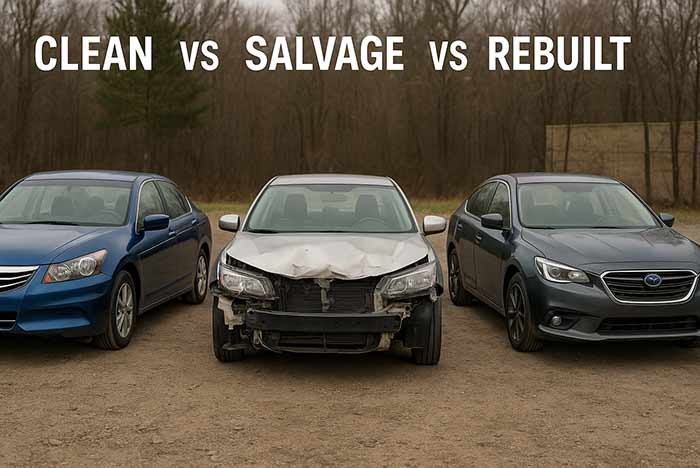
- Title status – clean means the car has not been declared a total loss; salvage means an insurer wrote it off and it is not roadworthy in the issuing state; rebuilt means it has been repaired and inspected after a salvage brand. We explain the differences in detail in clean vs salvage vs rebuilt titles, and the basics in what a car title is.
- Mileage – compare readings across all records (auction, service, registrations). A reading that goes backwards is a serious warning sign – see how to detect odometer rollback.
- Flood damage – a "flood" or "water damage" note in the auction description, silt and rust on seat rails, corroded connectors. More signs in our guide on how to spot flood damage.
- Theft – the free NICB VINCheck shows whether a car has been reported stolen or declared a total loss by a participating US insurer.
Red flags to watch for
Each of these deserves a closer look. Two or more together are a good reason to move on to the next car.
- The car has been a total loss or carries a salvage brand, and the seller does not mention itThe status shows on the title and in the history – look for contradictions.
- Brands such as junk, non-repairable or irreparableThe issuing state or province considers the car fit only for parts or scrap.
- A title recently issued in another state after a total-loss recordA possible sign of title washing – moving a car through a state with weaker rules so the brand disappears.
- Mileage that goes down between records or is marked “not actual”Without a true mileage you cannot judge wear or value.
- Deployed airbags without documented repairsMissing or poorly replaced safety systems are a serious risk.
- The VIN does not match on the dashboard, door and titlePossible cloned VIN or a title that belongs to another car.
Check the VIN before you bid
The free ProVinCheck VIN decoder shows factory data and the place of manufacture where available, and the full history report brings together available records on damage, title, mileage, flooding and theft – so you don't pay for someone else's problem.
- Mileage check
- Accident & damage
- Title & ownership
Even with a clean history, arrange an independent inspection in the USA or Canada if you can – we explain why in the importance of a pre-purchase inspection. For the wider process, see how to check a used car's history report.
Buying at a US or Canadian car auction
Many cars that end up in Europe are bought at insurance and online auctions such as Copart and IAA (Insurance Auto Auctions). If you prefer dealer and private listings, see our guides to the best websites for used cars in the USA and in Canada.
- Broker or direct account. Depending on the state and the title type, some lots can only be bought by licensed dealers, so many European buyers bid through a broker, a registered intermediary who bids, pays the auction and arranges transport. Get the broker's fee and every fee they will pass on in writing.
- Bidding. You can usually place a pre-bid before the sale and bid live online. Set your maximum including all costs, not just the hammer price.
- Auction fees. On top of the winning bid, auctions charge a buyer fee that rises with the price, plus fees such as gate/service, online bidding and environmental fees. Schedules differ for licensed and non-licensed buyers and change over time – check the official pages of Copart and IAA before bidding.
- Documents. Check which document comes with the car. A lot sold on a bill of sale only, without a title, or with "title pending" can cause problems at export (US Customs checks ownership documents) and later at registration in Europe.
- Collection. Inland transport to the port, usually by car carrier, is a separate cost that depends on distance – check which yard the car is in before bidding.
Auction deadlines cost money
Auctions give a short payment window and only a few free days to collect the car. After that, daily storage fees start, and late payment can trigger extra charges. Arrange collection before you win.
Which documents do you need from the purchase?
The purchase documents are needed three times: for export, for EU customs clearance and for registration. EU customs value is based on the price actually paid plus transport costs, so keep every invoice and payment record.
| Document | What it is | Why it matters in the EU |
|---|---|---|
| Title (Certificate of Title) | The ownership document issued by the state or province | Proves ownership and is usually presented as the previous registration document. Keep the original, and any separate registration card |
| Bill of sale / invoice | The sale document with price, VIN and parties | Basis for the customs value and proof of ownership at registration |
| Proof of payment | Bank transfer to the auction, dealer or broker | Supports the declared price if customs has doubts |
| Auction and broker invoices | Fees and the intermediary's commission | Affect the customs value and the VAT base |
| Transport and insurance invoices | Inland transport, ocean freight, insurance | Transport and insurance up to the EU border are part of the customs value |
| Bill of lading (B/L) | The ocean carrier's transport document | Needed for clearance and as proof of direct transport – essential when claiming 0% duty for a US car |
| Proof of origin | Evidence of where the car was made; for CETA, an origin declaration from the exporter | Without it you cannot claim 0% duty for US or Canadian origin |
National authorities may ask for translations of documents not in their official language.
Shipping the car to Europe
The typical route is:
auction or dealer → inland transport → US/Canadian port → ocean freight → EU port → customs clearance → approval → registration
- Container. The car is secured in a container, alone or in a shared container with 2–3 other cars, which lowers the price. Suitable for non-running cars.
- RoRo (roll-on/roll-off). The car is driven onto a specialised vessel. Often cheaper where a suitable line exists, but usually requires a car that runs.
- Port of arrival. Major North Sea ports such as Bremerhaven, Rotterdam and Antwerp handle large volumes of vehicles, but you can also ship to a port closer to home.
- Where to clear customs. Import VAT is normally due in the member state where the car enters the EU. If the car travels on under the external transit procedure, VAT is due where transit ends (Articles 60–61 of the VAT Directive). Decide this with your customs agent before the car arrives.
- Insurance. Transport insurance is optional, but without it any damage in transit is your loss. If you take it, it forms part of the customs value.
- Port costs. Unloading, container handling, temporary storage and agent fees are charged separately and rise with every day of delay.
Indicative shipping prices (checked October 2026)
Based on freight forwarders' published 2026 offers, port-to-port shipping of a passenger car from the US East Coast to North Sea ports such as Bremerhaven or Rotterdam is roughly USD 1,000–1,800 by shared container or RoRo, and more from the West Coast or for a dedicated container. These are commercial prices, not regulated fees. They depend on the departure port, car size, shipping method, season and fuel surcharges, and they exclude inland transport, insurance, unloading and port charges. Expect the whole journey from purchase to EU port to take several weeks. Always ask for a written all-in quote.
Customs duty and import VAT in the EU
This is where most mistakes are made – and where the old rule of thumb "10% duty plus VAT" is no longer always right.
Customs value
Duty and VAT are not calculated on the auction price but on the customs value. Under the Union Customs Code and the European Commission's customs valuation guidance, the starting point is the price actually paid or payable for the car (the transaction value), plus:
- transport and related costs up to the point of entry into the EU – inland transport to the port, ocean freight, loading;
- insurance of the shipment to the EU border;
- commissions and brokerage, except buying commissions – whether a particular intermediary's fee falls here depends on the contract and invoices.
Not included are transport after entry into the EU, interest, and the import duties and taxes themselves. Auction fees you pay to acquire the car are generally part of the price. If the declared value looks unusually low, customs can ask for further evidence – keep invoices and bank records.
Customs duty depends on origin, not on where you bought the car
The duty rate depends on two things: the tariff code in the Combined Nomenclature (CN/TARIC) and the car's origin.
Tariff code. Passenger cars fall under heading 8703, with subheadings by engine type, cylinder capacity and whether the car is new or used. Checked in the EU's tariff database (TARIC / Access2Markets) in October 2026:
| Used car | Example CN code | Standard duty (third countries) |
|---|---|---|
| Petrol, 1,500–3,000 cm³ | 8703 23 90 | 10% |
| Petrol, over 3,000 cm³ | 8703 24 90 | 10% |
| Diesel, 1,500–2,500 cm³ | 8703 32 90 | 10% |
| Diesel, over 2,500 cm³ | 8703 33 90 | 10% |
| Fully electric | 8703 80 90 | 10% |
| Pickup classified as a goods vehicle (heading 8704) | 8704 21 / 8704 31 … | 10% or 22% depending on the subheading |
Many American pickups can be classified either as passenger cars (8703) or as goods vehicles (8704) depending on their design. Customs decides the classification, and the difference in rate can be significant.
Origin. For customs purposes, "origin" means the country where goods were wholly obtained or underwent their last substantial processing – for a car, that is normally the country where it was manufactured. The country where you bought it does not decide origin on its own:
- A BMW built in Germany and bought in Canada does not have Canadian origin.
- A Toyota built in Japan and bought in the USA does not have US origin.
- A car assembled in the USA (VIN starting with 1, 4 or 5) may have US origin – if that can be proven.
US-origin cars: 0% under Regulation (EU) 2026/1455
With Regulation (EU) 2026/1455 of 25 June 2026, the EU implements its commitment in the EU–US Joint Statement of 21 August 2025 to eliminate duties on US industrial goods. What matters for cars:
- Annex I covers the whole of CN Chapter 87 ("Vehicles other than railway or tramway rolling stock…"), so headings 8703 and 8704 are included.
- Goods in Annex I originating in the United States are subject to 0% duty (Article 1).
- The Regulation applies from 1 July 2026 until 31 December 2029 (Article 8), unless extended.
- Origin is determined by the non-preferential rules of origin of the Union Customs Code (Article 6) – in practice, where the car was made.
- The Commission can suspend the preference in whole or in part, for example if the US fails to implement the Joint Statement (Article 3), or adopt safeguard measures (Article 4). On 5 October 2026 the measure was in force in TARIC for Chapter 87 codes.
How origin is proven. There is no standard certificate. According to the Commission's Q&A on the new Article 59a of Implementing Regulation (EU) 2015/2447, the principle of free evidence applies, but:
- a "Made in USA" label, an origin statement on an invoice or a certificate of origin are not sufficient on their own – the importer needs further evidence for the specific case;
- proof of origin includes proof of direct transport from the US to the EU (for example a bill of lading and sales and transport contracts) or, if the car passed through a third country, proof that it stayed under customs supervision and was not altered;
- the evidence must be in your hands when the customs declaration is lodged; the declaration uses preference code 300 and document code U190;
- if the evidence is not accepted, 0% does not apply and the standard duty is charged (Access2Markets).
In practice, find out before you buy where the car was built and what evidence you can gather (manufacturer data, the manufacturer's plate and VIN, purchase and transport documents). What customs will accept for a specific used car is decided case by case – discuss it with your customs agent before you bid.
A US-built car bought in Canada
If a car built in the USA was imported into and used in Canada and is shipped from a Canadian port, the requirement for direct transport from the US to the EU will generally not be met – and 0% under Regulation 2026/1455 cannot be claimed.
Canadian-origin cars: CETA
The EU–Canada Comprehensive Economic and Trade Agreement (CETA) provides 0% duty for goods of preferential Canadian origin. In TARIC, the CETA preference for used passenger cars (for example 8703 23 90) is 0%. The conditions are strict (Protocol on rules of origin):
- CETA origin. The car must meet the product-specific rule of origin for vehicles, which limits the value of materials not originating in Canada or the EU. Assembly in Canada alone is not proof.
- Origin declaration. The preference is claimed with an origin declaration on an invoice or other commercial document, completed by the exporter in Canada using the text in Annex 2 of the Protocol (Articles 18–19). The exporter must be able to prove origin with documents, including from the producer or suppliers.
- Validity. The declaration is valid for 12 months from when it was completed (Article 20).
- Transport. If the car passes through a third country – for example, it is shipped from a US port – it must stay under customs control and must not be processed (Article 14). Customs may ask for the bill of lading and transit documents (Article 22).
- Origin quota. CETA also has an annual quota for vehicles exported from Canada under more flexible origin rules, but it requires an export permit issued by Canada – in practice a tool for manufacturers and large exporters.
For a used car bought at auction or from a private seller, getting a valid origin declaration can be difficult, because the seller needs origin information. The Protocol allows the declaration to be completed after export and provides for refunds of duty if origin is proven later – check the deadlines and procedure with customs. Without an origin declaration, the standard duty applies (10% for passenger cars).
Duty by scenario
| Situation | Duty (passenger car, heading 8703) |
|---|---|
| Built in the USA, bought in the USA, shipped directly from a US port, origin and transport proven | 0% (Regulation 2026/1455) |
| Built in the USA, but origin or direct transport not proven | 10% |
| Built in Canada, with a CETA origin declaration from the Canadian exporter | 0% (CETA) |
| Built in Canada, no origin declaration | 10% |
| Built in Japan, Korea or Mexico, bought in the USA or Canada | Usually 10% – the preference under the EU's agreement with that country needs its own proof of preferential origin, rarely available for a used car from North America |
| Built in the EU (e.g. Germany), bought in the USA or Canada | 10% – EU origin alone gives no 0% on re-import; relief for "returned goods" applies only under strict conditions, such as return within three years of export |
How much is the EU import duty on a car from the USA?
The standard EU duty on a used passenger car from a non-EU country is 10%. From 1 July 2026 to 31 December 2029, a car of proven US origin, shipped directly from the US, pays 0% under Regulation (EU) 2026/1455. If the car was not made in the US or its origin cannot be proven, 10% applies. Duty is calculated on the customs value (price + fees + transport and insurance to the EU border).
Classic cars over 30 years old
Some older cars can be classified not as ordinary vehicles but as collectors' pieces of historical interest under CN heading 9705, which changes the customs treatment, and some member states also apply a reduced VAT rate to imports of collectors' items. According to the EU Court of Justice (case C-259/97), motor vehicles in their original state (without substantial changes to the chassis, steering, brakes or engine), at least 30 years old and of a model no longer in production are presumed to be of historical interest, but they must also be genuine collectors' pieces – relatively rare, not normally used for their original purpose, traded outside the normal used-car market and of high value. Classification is strict and decided by customs; ask for an assessment before you buy.
Import VAT
Every member state charges import VAT on cars from outside the EU, regardless of whether you bought from an auction, a dealer or a private seller. Standard rates range from 17% in Luxembourg to 27% in Hungary (Your Europe – VAT rates). Under Articles 85–86 of the VAT Directive, the taxable amount is the customs value plus, where not already included:
- customs duty and other taxes and charges due on importation (excluding VAT itself);
- incidental expenses – commission, packing, transport and insurance – up to the first place of destination in the member state of importation.
How import VAT is calculated: VAT = national VAT rate × (customs value + customs duty + incidental costs after the EU border up to the first destination).
That is why VAT always works out at more than the VAT rate applied to the auction price. With 0% duty the base is lower, but VAT is still due in full. The EU's "new car" and "used car" VAT definitions matter for cars bought inside the EU; a car bought outside the EU pays customs duty and import VAT like any other imported goods, whether new or used (Your Europe).
Exception: moving to the EU
If you are transferring your normal residence to an EU country after living outside the EU for at least 12 consecutive months, and you have used the car there for at least six months, it can normally be imported free of duty and VAT as personal property (Regulation (EC) No 1186/2009, Articles 3–11; see also the European Commission). The car generally has to be declared within 12 months of settling and cannot be sold, lent or pledged for 12 months without notifying customs. You still have to register it and pay national car taxes.
Worked example: what an imported car really costs
This example is indicative. Purchase, fees, transport, repairs and services are assumptions to show how the calculation works. Only the duty rates and the VAT method are set by law. The example uses a member state with a 21% standard VAT rate and no registration tax; substitute your own country's VAT rate and car taxes. Amounts are in euros; in a real import, customs converts US or Canadian dollars at the applicable rate.
Assumption: a six-year-old petrol SUV built in the USA, bought at auction and shipped in a shared container to a North Sea port.
| Item | Scenario A: US origin proven | Scenario B: origin not proven |
|---|---|---|
| Auction price | €11,000 | €11,000 |
| Auction fees (assumed) | €900 | €900 |
| Inland transport to the port (assumed) | €450 | €450 |
| Ocean freight incl. loading (assumed) | €1,400 | €1,400 |
| Transport insurance (assumed) | €150 | €150 |
| Customs value | €13,900 | €13,900 |
| Customs duty (8703 23 90 or 8703 24 90) | 0% → €0 | 10% → €1,390 |
| Unloading, port handling and delivery to first destination (assumed) | €300 | €300 |
| VAT base | €14,200 | €15,590 |
| Import VAT at 21% | €2,982 | €3,274 |
| Customs agent (assumed) | €200 | €200 |
| Inspection and individual approval (assumed, varies by country) | €600 | €600 |
| Technical changes: indicators, rear fog lamp, headlamps (assumed) | €700 | €700 |
| Registration fees and plates (assumed, varies by country) | €100 | €100 |
| Repairs (assumed) | €1,500 | €1,500 |
| Contingency (assumed) | €500 | €500 |
| Approximate total (before insurance and any registration tax) | ≈ €20,782 | ≈ €22,464 |
The takeaway: in this example a car won at auction for €11,000 costs almost twice as much by the time it is registered, and proven US origin saves about €1,680 in duty and the VAT on that duty. If the car had been built in Germany or Japan, scenario B would apply even though it was bought in the USA. For a fully worked Bulgarian example with Bulgarian fees, see our Bulgarian-language guide.
What needs to change on a US or Canadian car?
The legal requirement is that the car meets the technical requirements that your national approval authority applies to it. Across the EU, those requirements are built on the same UN regulations, so the typical changes are similar everywhere. But which changes a particular car needs depends on the model, the year and how it is equipped – some North American cars already comply on some points – and the final decision lies with the approval authority or technical service in your country.
| Item | What the rule requires | What is common on North American versions | Does it depend on the model? |
|---|---|---|---|
| Rear indicators | Direction indicators emit amber light – UN Regulation No 48, para. 5.15 | Red rear indicators combined with the brake lights | Yes – many models already have amber rear indicators |
| Rear fog lamp | Mandatory, red – UN Regulation No 48, para. 6.11 | Often missing | Yes |
| Headlamps (dipped beam) | Lighting devices must meet the applicable approval requirements | Headlamps built to US standards; beam pattern and approval may not comply | Yes – sometimes an EU-specification unit is needed |
| Speedometer | Graduated in km/h; switching between km/h and mph is allowed if only one unit shows at a time and it is labelled – UN Regulation No 39 | US cars often show mph first; Canadian cars usually km/h | Yes – on digital clusters it is often a setting or coding change |
| Side markers and reflectors | Colour and position assessed under UN Regulation No 48 | North American side-marker layout | Yes |
| Number-plate mounting | The European plate must fit and be lit | Mounting made for the smaller US plate | An adapter is often needed |
| Emissions and noise | Compliance as assessed by the approval authority | Approved under US or Canadian rules | Tests or documents may be required |
Keep three things apart: what is mandatory is compliance with the applicable rules; the typical changes are indicators, rear fog lamp, headlamps and km/h display; what is model-specific can only be confirmed by the approval authority or technical service. The safest approach is to send the VIN and photos to them before you buy and ask for a list of required changes.
Individual vehicle approval (homologation)
Cars built for the North American market normally have no EU type-approval and therefore no European certificate of conformity (CoC), which the manufacturer only issues for vehicles that conform to an approved EU type (Regulation (EU) 2018/858, Article 3(5)). Without a CoC, the route to registration is usually an individual vehicle approval – in everyday language "homologation", although strictly speaking homologation means type-approval.
Regulation (EU) 2018/858 sets the EU framework:
- EU individual vehicle approval (Article 44) – granted for a vehicle meeting the EU requirements; every member state must accept a valid EU individual approval certificate for registration.
- National individual vehicle approval (Article 45) – granted under alternative requirements set by a member state; its validity is limited to that member state, although other member states should normally accept it unless they have reasonable grounds to believe the requirements are not equivalent (Article 46).
- In both cases, authorities may not carry out destructive tests and must use relevant information provided by the applicant (Articles 44(3) and 45(3)).
How a used car previously registered in the USA or Canada is approved in practice is set by national rules, so the procedure, the authority and the cost differ by country. Two examples:
- Germany – a vehicle that does not belong to an approved type needs an individual operating permit (Einzelbetriebserlaubnis) based on a report by an officially recognised vehicle expert or a designated technical service (§ 21 StVZO).
- Bulgaria – a designated technical service issues an identification protocol and the Road Transport Administration (IAAA) issues an individual approval certificate under Ordinance No N-3, checked against the requirements in force on the date of the car's first registration. The certificate is valid only in Bulgaria. Details are in our Bulgarian guide.
Before buying, ask the approval authority or a technical service in your country what the procedure involves for that specific model and year, which documents they need and what it is likely to cost.
Registering a US or Canadian car in an EU country
There is no EU-wide law on vehicle registration: as a rule, you register the car in the country where you have your normal residence, under that country's rules (Your Europe). Typical requirements include:
- Proof of identity and residence.
- Proof of ownership – the title and the bill of sale or invoice.
- The customs clearance document and proof that import VAT has been paid.
- An EU type-approval document or CoC or, for most North American cars, the individual approval certificate.
- A roadworthiness inspection, where your country requires one for imported cars.
- Motor insurance.
- Payment of registration fees and any national registration tax.
Car taxes are national. Registration taxes and annual road taxes are not harmonised in the EU: some member states charge little or nothing at registration, while others levy substantial one-off registration taxes. There are no EU rules on the level of car taxation (European Commission FAQ on passenger car taxation), so check your country's rules before you calculate the landed cost.
How much does a car from the USA or Canada really cost?
Think of the final price as a sum, not as the auction price:
Landed cost = purchase price + auction fees + broker + inland transport + ocean freight + port costs + customs agent + customs duty (if due) + import VAT + technical changes + individual approval + registration fees and taxes + insurance + repairs + contingency
10%
Standard duty
Used passenger car from a non-EU country (CN 8703)
0%
Duty with proven origin
USA under Regulation 2026/1455; Canada under CETA with an origin declaration
17–27%
Import VAT
Standard rate of the member state of importation
2029
US 0% end date
The US preference applies until 31 December 2029 unless extended or suspended
Separate the two kinds of cost:
| Set by law (you can know them in advance) | Commercial and variable (ask for quotes) |
|---|---|
| Customs duty – 0% or 10% (22% for some goods vehicles) depending on code and origin | Auction and broker fees |
| Import VAT – your country's rate on the VAT base | Inland and ocean transport, insurance |
| Approval and registration fees set by your national authorities | Port costs, storage, customs agent |
| National registration and road taxes | Technical service fees and the technical changes |
| Insurance, repairs, parts |
The most common mistake is to count only the price, the shipping and "duty plus VAT". That shortcut is wrong for a car of proven US origin, and incomplete for every car, because it ignores approval, conversion, repairs, national car taxes and delays.
The biggest risks with cars from the USA and Canada
Red flags to watch for
Most problems are manageable if you know about them before buying. The expensive ones are those you discover afterwards.
- Severe accident damageAuction photos rarely show everything. Hidden structural damage can multiply the repair cost.
- Flood carsCorrosion in electronics and connectors can appear months later. A flood note or signs of water are a serious warning.
- Deployed or missing airbagsReplacing airbags, belts and control units is expensive and a safety matter.
- Title washingA damage brand that disappeared after re-titling in another state. Compare the history with the current title.
- Mileage discrepanciesRolled-back or not-actual mileage, especially where miles and kilometres are mixed in the records.
- Incomplete documentsA lot without a title, a wrong VIN on the title or missing invoices can block export, customs or registration.
- Higher auction fees than expectedFees rise with the price and are not included in the amount you see while bidding.
- Storage and delaysLate collection, port delays or waiting for paperwork are charged by the day.
- Difficult or impossible approvalSome cars need expensive changes or tests to meet the requirements applied in your country.
- Parts availability in EuropeParts specific to North American versions sometimes have to be ordered from across the Atlantic.
- Wrong assumption about originIf you budgeted for 0% duty and customs does not accept the origin evidence, you pay 10% plus more VAT.
Checklist before you buy a car from the USA or Canada
Before you bid
0 of 16 checked
Frequently asked questions about importing a car from the USA or Canada to the EU
Official sources and useful links
Customs duty, origin and VAT
- Regulation (EU) 2026/1455 – customs duties on goods originating in the US (EUR-Lex)
- Access2Markets – new EU tariff duties on goods from the US from 1 July 2026
- European Commission – Q&A on Article 59a of Implementing Regulation (EU) 2015/2447
- European Commission – non-preferential rules of origin
- European Commission – TARIC
- Access2Markets
- CETA – EU–Canada agreement (Access2Markets)
- CETA – Protocol on rules of origin
- European Commission – customs valuation quick info
- VAT Directive 2006/112/EC (EUR-Lex)
- Your Europe – VAT rules and rates
- Your Europe – VAT when buying a car abroad
- European Commission – buying and selling cars
- Regulation (EC) No 1186/2009 – reliefs from customs duty (EUR-Lex)
- Court of Justice, case C-259/97 – vehicles as collectors' pieces (EUR-Lex)
Approval, technical requirements and registration
- Regulation (EU) 2018/858 – type-approval and individual vehicle approval (EUR-Lex)
- UN Regulation No 48 – installation of lighting (EUR-Lex)
- UN Regulation No 39 – speedometer (EUR-Lex)
- Your Europe – car registration documents and formalities
- European Commission – FAQ on passenger car taxation
- Germany – § 21 StVZO, individual operating permit
- Bulgaria – Ordinance No N-3 on individual approval (lex.bg)
Vehicle history and export from North America
- NMVTIS – information for consumers (US Department of Justice)
- NICB VINCheck – free theft and total-loss check
- Ontario – Mandatory Vehicle Branding Program
- US Customs and Border Protection – exporting used vehicles
Last reviewed: 5 October 2026. Regulations, tariff measures, VAT rates and fees can change – before importing a specific car, confirm the current requirements with your national customs authority, vehicle approval authority and registration office, or consult a licensed customs agent.