Best Tire Pressure for Fuel Economy – TPMS Light & Gas Mileage Guide
Under-inflated tires can quietly cost you up to 3% in fuel economy. Learn the best tire pressure for your car, how to check it properly, what the TPMS light means, and how pressure affects safety and tire life.
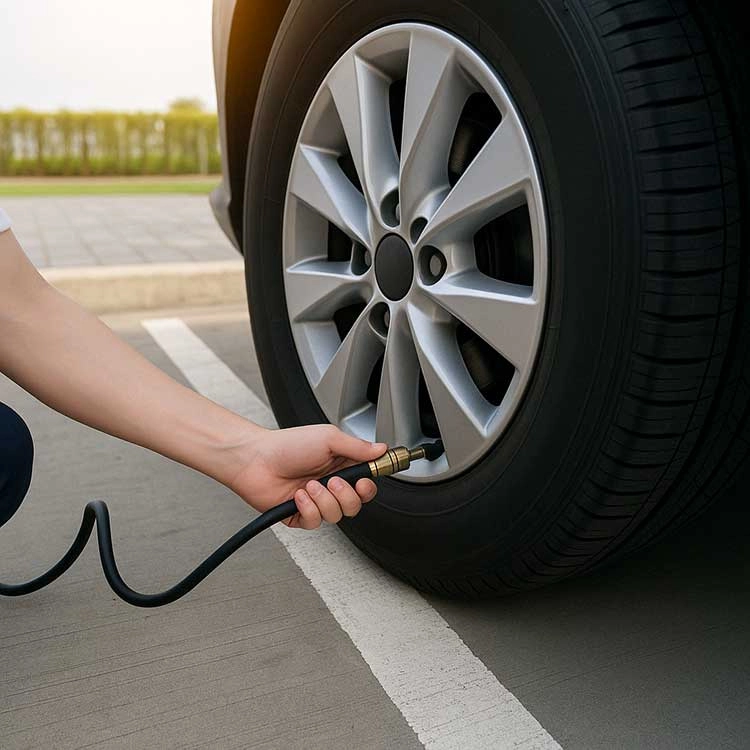
Are you aware that something as simple as under-inflated tires can reduce your fuel economy by up to 3%? That means paying more for fuel simply because your tires aren't at their optimal pressure. Tire pressure is often overlooked, but it is one of the easiest ways to improve your car's performance and save money on gas.
Under-inflated tires significantly increase the rolling resistance of the wheels, which forces the engine to work harder. Studies indicate that tires 10% under-inflated can lead to a 2% increase in fuel consumption, while 20% under-inflation can increase it by as much as 4%.
32–35 psi
Typical recommended range
Your car's exact value is on the driver's door sticker.
Up to 3%
Fuel economy at stake
The gain from keeping tires at the recommended pressure.
0.2% / psi
Cost of under-inflation
Fuel economy lost for every 1 psi below spec.
1× / month
Check frequency
Always when tires are cold — plus before long trips.

Speed also plays a role — the penalty of under-inflation varies with it. At lower speeds (e.g., 40 mph), tires at 50% of their recommended pressure can reduce fuel economy by about 10%, but this penalty decreases to around 5% at higher speeds (80 mph).

You can improve your fuel consumption by 0.6% on average — and up to 3% — simply by keeping your tires inflated to the proper pressure. Look at it this way: less air in the tire means more tire surface in contact with the ground. So for every psi drop, about 0.2% more fuel is needed to move the tire.
| Tire Pressure Condition | Fuel Economy Impact |
|---|---|
| Recommended Pressure | Up to 3% improvement |
| 10% Under-Inflation | ~2% increase in fuel consumption |
| 20% Under-Inflation | ~4% increase in fuel consumption |
| Every 1 PSI drop | ~0.2% decrease in fuel economy |
Maintaining proper tire pressure not only enhances fuel efficiency but also improves vehicle safety and prolongs tire life. Regularly checking and adjusting tire pressure is a simple yet effective way to optimize vehicle performance and reduce fuel costs.
What is the Best Tire Pressure for Fuel Economy?
The best tire pressure for optimal fuel consumption is typically the manufacturer's recommended pressure, which can be found on the sticker inside the driver's door or in the owner's manual. The manufacturer designs this pressure to be perfectly balanced for safety, performance, and fuel efficiency.

The importance of manufacturer recommendations: while 32–35 psi is a good general range, the ideal tire pressure for your vehicle may differ. Vehicle manufacturers design each model with specific tire pressures in mind, considering factors such as vehicle weight, balance, and handling. Using the manufacturer-recommended tire pressure helps ensure that your car runs efficiently and safely. The recommended tire pressure can typically be found:
- On a sticker located inside the driver's door frame
- Inside the vehicle's owner's manual
- Occasionally, on the fuel door or glove compartment
Following these guidelines not only supports fuel economy but also helps maintain proper tire wear and enhances handling. It's important to remember that both under-inflation and over-inflation can negatively affect your vehicle's performance.
How to Check Your Tire Pressure
With just a few simple tools and steps, you can ensure your tires are properly inflated and your vehicle is operating at peak efficiency. Checking your tire pressure regularly — at least once a month — is ideal for staying on top of any air loss that could impact fuel economy and handling.
What you'll need: a tire pressure gauge. These come in various types:
- Digital gauges: easy to read and accurate, with a digital display.
- Dial gauges: traditional gauges with an analog display.
- Pencil-style gauges: compact and affordable, though sometimes less accurate than digital models.
You can find tire pressure gauges at auto parts stores, big-box stores, and online. Additionally, most gas stations have air pumps with built-in gauges, though their accuracy may vary.
Checking tire pressure in 7 steps
Takes about five minutes for all four tires — do it monthly and before long trips.
Start with cold tires
Tire pressure fluctuates with temperature, so check when tires are cold: wait at least three hours after driving, or check first thing in the morning before the day warms up.
Find the recommended pressure
Look for the recommended psi on the sticker inside the driver's door frame, in the vehicle manual, or sometimes on the fuel door. This value gives you the best pressure for fuel efficiency, safety and comfort.
Remove the valve cap
Unscrew the cap from the tire's valve stem — the small rubber or metal tube sticking out from the tire. Set the cap aside where it won't get lost.
Press the gauge onto the valve stem
Press the gauge down firmly until you hear a short hiss and it registers the pressure. If the hissing continues, adjust the gauge until it fits snugly for an accurate reading.
Read the pressure
Compare the reading to the manufacturer's recommended psi. Too low means you need to add air; too high means you should release some.
Adjust as needed
To add air, use an air compressor (most gas stations have one) and fill in short bursts, re-checking frequently to avoid over-inflation. To release air, press the small pin inside the valve stem in short bursts and re-check.
Replace the valve cap
Screw the cap back onto the valve stem — it protects the valve from dirt and debris. Repeat for all four tires and the spare.
Best Practices for Tire Pressure Maintenance
Check when tires are cold: always check tire pressure when tires are cold for the most accurate reading.
Monitor seasonal changes: as the temperature drops, so does your tire pressure. For every 10°F (5.5°C) drop, tire pressure decreases by about 1 psi, so it's crucial to check pressure more often in colder months.
Don't forget the spare tire: regularly check the spare tire's pressure as well, so you'll have a properly inflated spare ready if needed.
Pro tip
Pair the monthly pressure check with a quick look at the tread: uneven wear across a tire usually means a pressure problem, while uneven wear between tires points to skipped tire rotations or an alignment issue.
By following these simple steps and best practices, you can ensure that your tires are always at the best pressure — improving fuel economy, enhancing handling, and extending the life of your tires. Consistent tire maintenance is one of the easiest ways to keep your vehicle running safely and efficiently, and it belongs in every car maintenance routine.
The Impact of Over-Inflation and Under-Inflation
Maintaining the correct tire pressure is important not only for fuel efficiency, but also for safety and balanced tire wear. Both over-inflation and under-inflation can negatively impact the performance of your vehicle and result in added expenses — from increased fuel consumption to premature tire wear and potential safety hazards.

The Dangers of Under-Inflated Tires
Decreased traction: low pressure reduces the tire's grip on the road, particularly in wet conditions, increasing the likelihood of hydroplaning.
Excessive heat buildup: the increased friction caused by under-inflation generates excess heat, which can weaken the tire's structure and lead to blowouts.
Uneven and rapid wear: under-inflated tires tend to wear out on the edges faster than in the center, shortening their overall lifespan and requiring more frequent replacements.
The Dangers of Over-Inflated Tires
Reduced traction and comfort: over-inflated tires provide a rougher ride, as they don't absorb road irregularities as well. This leads to less comfortable driving and reduced traction, especially on rough or uneven surfaces.
Increased risk of tire damage: because over-inflated tires are more rigid, they are more susceptible to damage from road hazards such as potholes or debris. Hitting an obstacle with over-inflated tires increases the risk of punctures or blowouts.
Uneven wear patterns: over-inflated tires wear down the center tread more quickly than the edges, leading to shorter tire life and more frequent replacements.
Watch out
A tire that keeps losing pressure week after week is not normal. It usually means a slow puncture, a leaking valve stem or a corroded wheel rim — have it inspected before it fails at speed.
What Does the TPMS Light Mean?
The Tire Pressure Monitoring System (TPMS) is the horseshoe-shaped warning light with an exclamation mark on your dashboard. It comes on when at least one tire is significantly under-inflated — typically 25% or more below the recommended pressure.
When the light comes on:
- Check all four tires (and the spare, if it has a sensor) with a gauge as soon as convenient — don't rely on looks; a tire can be 20% low and appear normal.
- Inflate to the door-sticker value and see if the light goes out after a short drive.
- If it returns, one tire likely has a slow leak — have it inspected.
- If it flashes on start-up, the TPMS itself has a fault (often a dead sensor battery) and needs service.
Remember: by the time TPMS warns you, you've already been losing fuel economy and tire life for a while. It's a safety net, not a maintenance tool — the monthly manual check is still essential.
Common Tire Pressure Mistakes
Common mistakes to avoid
Inflating to the psi printed on the tire sidewall.
Do this instead: That number is the tire's maximum, not the recommendation. Use the vehicle's door-sticker value.
Checking pressure right after driving.
Do this instead: Warm tires read 2–4 psi high. Check cold — after 3+ hours parked or first thing in the morning.
Waiting for the TPMS light instead of checking monthly.
Do this instead: TPMS triggers only at ~25% under-inflation — you lose fuel and tire life long before it warns you.
Ignoring the spare tire.
Do this instead: Check the spare at least every few months — a flat spare is no spare at all.
Not adjusting for the seasons.
Do this instead: Re-check after the first cold snap: a 30°F (17°C) temperature drop costs about 3 psi.
Checking Tires on a Used Car
Tires are a 5-minute check that reveals a lot about a used car — and a four-tire replacement can cost $400–$1,000+, so it belongs in your price negotiation.
- Tread wear pattern: even wear across all four tires suggests good care. Edges worn (chronic under-inflation), center worn (over-inflation), or one side worn (alignment or suspension issues) all tell a story.
- Matching tires: four different brands or ages suggest the owner bought the cheapest fix each time — ask what else was done cheaply.
- Tire age: check the DOT date code on the sidewall; tires over 6–8 years old need replacing regardless of tread.
- Uneven wear between axles: points to skipped rotations, or on AWD cars, potential drivetrain stress.
Worn or mismatched tires are visible. What isn't visible is why: an alignment knocked out in an accident, worn suspension, or plain neglect. A pre-purchase inspection will find the mechanical cause — and the vehicle's history report will tell you if an accident started it.
Uneven tire wear? Check the car's accident history
Misalignment and odd tire wear are often the visible aftermath of a crash. A ProVinCheck report reveals recorded accidents, damage history, mileage records and title status — before you inherit someone else's problem.
- Mileage check
- Accident & damage
- Title & ownership